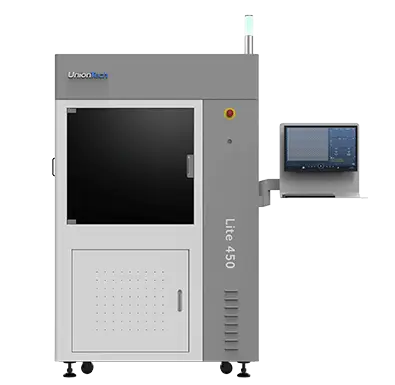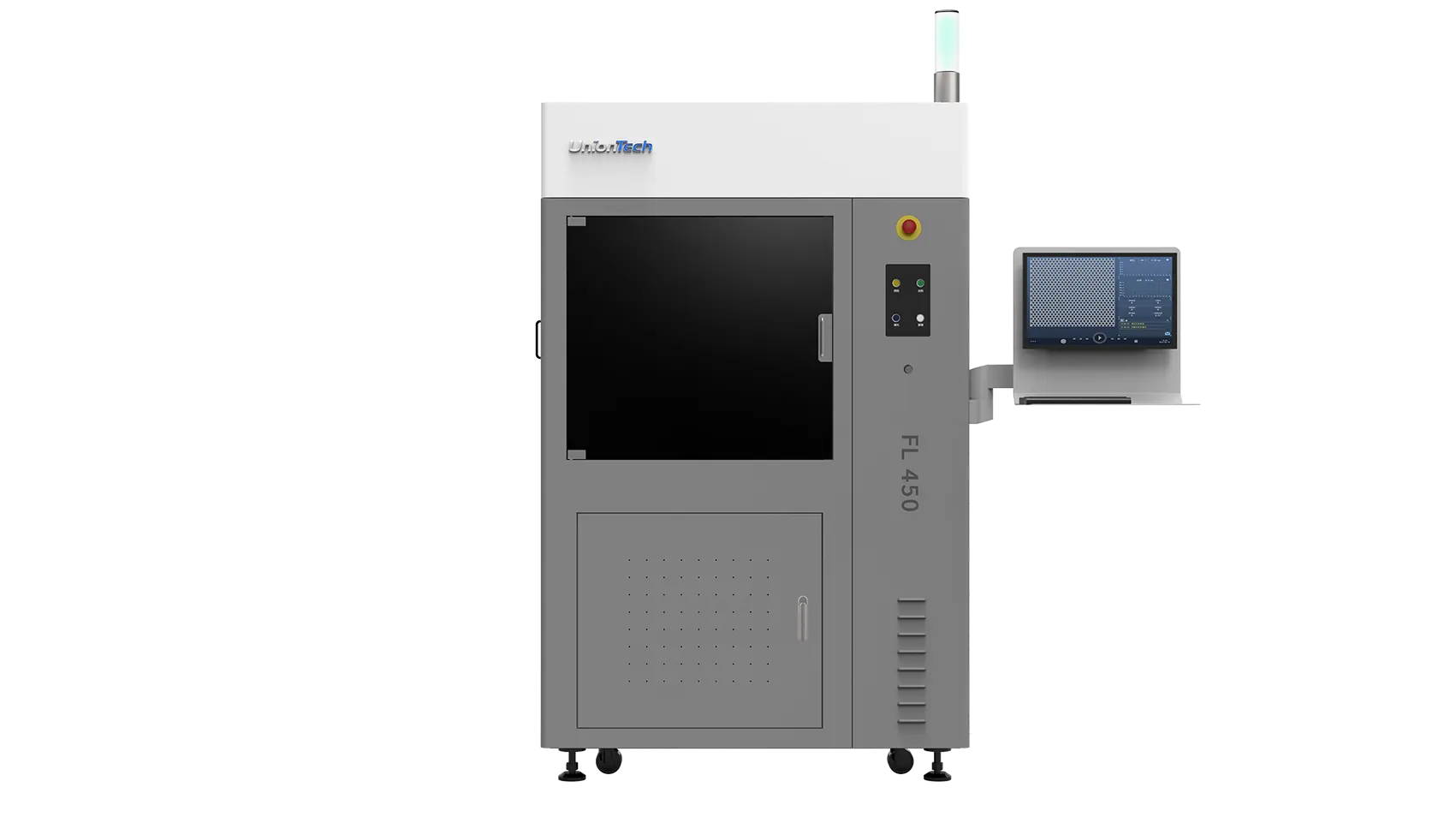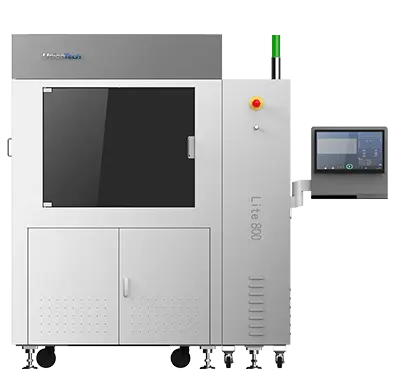
In the world of resin-based additive manufacturing, two technologies stand out for their ability to produce highly detailed parts: Stereolithography (SLA) and Digital Light Processing (DLP). While both utilize a light source to cure liquid photopolymer resin, the mechanics of a DLP 3D printer offer a unique approach to speed that has made it a popular choice for high-throughput applications, particularly in the dental and small-batch sectors.
Understanding how a DLP 3D printer works—and where it differs from its SLA counterpart—is crucial for any professional seeking an industrial 3D printer solution.
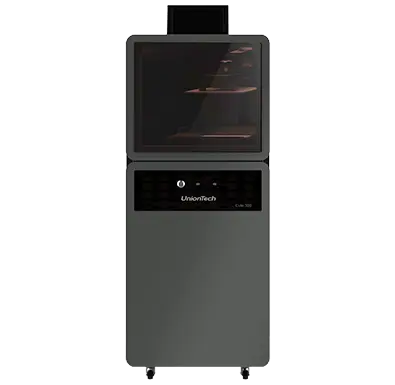
How a DLP 3D Printer Works
Digital Light Processing (DLP) technology was first developed by Texas Instruments for use in video projectors. In a 3D printer application, this technology is adapted to cure an entire layer of resin simultaneously, rather than tracing it out point-by-point.
Light Source: Instead of the UV laser used in SLA, the DLP 3D printer uses a digital light projector, often featuring an industrial-grade 4K optical engine in professional systems.
The Digital Micromirror Device (DMD): The projector houses a DMD chip. This chip is an array of millions of tiny, independently controlled mirrors (one for each pixel). To cure a layer, the light is reflected by these mirrors, creating a perfect, two-dimensional mask of the entire layer’s cross-section.
Simultaneous Curing: This 3D “image” is flashed onto the bottom of the resin tank. The light instantly cures all the resin in that projected area at once.
Speed Advantage: Because an entire layer is cured in a single exposure, the print time per layer is constant, regardless of the part’s size or complexity across the build platform. This gives dlp 3D printer systems their significant speed advantage over SLA, especially when printing multiple small parts or larger, solid volumes.
For example, UnionTech offers high-performance dlp 3D printer models, which features a 3840 x 2160 HD resolution and a 192 x 108 x 200 mm build volume. This level of industrial integration allows for rapid batch production of items like dental models and investment casting patterns.
DLP vs. SLA: A Critical Industrial Comparison
While the speed of a dlp 3D printer is undeniable, the choice between DLP and SLA for true industrial-scale manufacturing ultimately hinges on three key factors: resolution, build volume, and surface quality.
| Feature | DLP 3D Printer (e.g., UnionTech π200) | SLA 3D Printer (e.g., UnionTech RSPro Series) |
| Curing Method | Fulllayer flash (Projector/DMD) | Point-by-point trace (UV Laser) |
| Print Speed | Significantly Faster (Consistent time per layer) | Slower (Time scales with part area) |
| Max Build Volume | Generally Smaller (Limited by projector lens size/focus) | Significantly Larger (Laser can scan any size platform) |
| Resolution/Surface | Good, but can exhibit “pixelation” | Excellent and UltraSmooth (Continuous laser path) |
| Key Advantage | High-throughput, fast iteration on smaller parts | Ultrahigh precision, large-format production, perfect surface finish |
The Limitation of DLP Scaling
The most critical difference in the industrial 3D printer space is scalability. The resolution of a dlp 3D printer is fixed by the number of pixels on its DMD chip. If you try to increase the build area (by magnifying the projection), the pixel size must also increase, which lowers the resolution and dimensional accuracy of the printed part. This fundamental limitation constrains DLP printers to smaller build volumes.
Why SLA Remains the Industrial Gold Standard
For high-end, large-format, and mission-critical production—the domain of the true industrial 3D printer—Stereolithography maintains its superiority.
Leading industrial 3D printer manufacturer companies, such as UnionTech, often focus their core large-format technology on SLA because it completely overcomes the size limitation of DLP. In SLA, the laser spot size (UnionTech’s Pilot 250 offers a beam size of 0.06–0.08 mm) remains constant regardless of the size of the build platform.
The UnionTech RSPro series, for instance, can offer build volumes up to 1800 x 700 x 500 mm, which is simply unachievable with the current constraints of DLP technology without massive loss of resolution. Furthermore, the continuous, smooth path of the laser in SLA results in parts with an exceptional surface finish that rivals injection molding, free from the voxel-based stair-stepping artifacts that can sometimes affect DLP parts on complex curves.
This precision is critical for applications like master patterns, complex functional prototypes, and final assemblies in aerospace, automotive, and large tooling industries.
Conclusion
A DLP 3D printer is a high-speed, high-resolution tool best suited for rapid, smallbatch manufacturing and specific applications like dentistry, where throughput is king and parts are smaller. However, for companies needing the absolute highest precision, the smoothest surface finish, and the ability to scale to massive build volumes, the laser-based SLA technology—championed by industrial 3d printer manufacturer leaders like UnionTech—remains the undisputed industrial 3D printer standard. The ability of SLA to maintain submillimeter accuracy over an enormous build platform ensures its continued relevance at the top tier of additive manufacturing.