In the dynamic world of additive manufacturing, two technologies often stand out as the workhorses for producing plastic parts: Fused Deposition Modeling (FDM) and Stereolithography (SLA). While both are used extensively, their underlying mechanisms lead to significant differences in part quality, particularly in dimensional accuracy and surface finish. For industries with rigorous standards, such as the automotive sector, choosing the right technology is critical.
The simple answer to “Is SLA 3D printing technology more accurate than FDM?” is a definitive yes, especially when manufactured by a leading industrial 3D printer manufacturer like UnionTech. This superior precision is the primary reason why SLA has become indispensable in the workflow of modern 3D printing in automotive industry.
The Fundamental Difference in Process
To understand the gap in accuracy, one must look at how each technology builds a part.
FDM (Fused Deposition Modeling): FDM, or Fused Filament Fabrication (FFF), works by melting a thermoplastic filament and extruding it layer by layer through a heated nozzle.
Process: Extrusion of molten plastic.
Accuracy Constraint: The nozzle size dictates the minimum feature size. The thermal process (melting and cooling) introduces potential issues like warping and anisotropy (uneven strength across different axes). The layer lines are generally more visible, requiring extensive post-processing for a smooth finish.
Typical tolerances: Approximately ±0.10 mm to ±0.25 mm for industrial FDM systems.
SLA (Stereolithography): SLA 3D printing technology uses a high-precision laser (or projector) to selectively cure liquid photosensitive resin, hardening it layer by layer.
Process: Photopolymerization of liquid resin.
Accuracy Advantage: The size and focus of the laser spot are significantly smaller and more controllable than an FDM nozzle. Because the resin is cured by light rather than melted by heat, the process involves less thermal stress, resulting in much less warping and superior isotropic properties (uniform strength and stiffness).
UnionTech’s Industrial SLA: Defining the Precision Standard
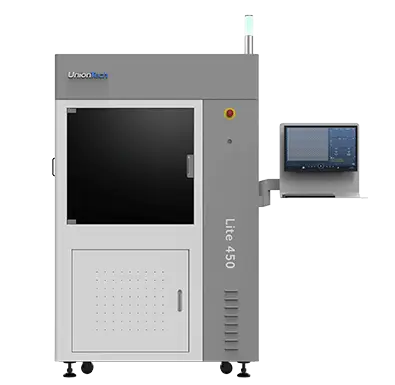
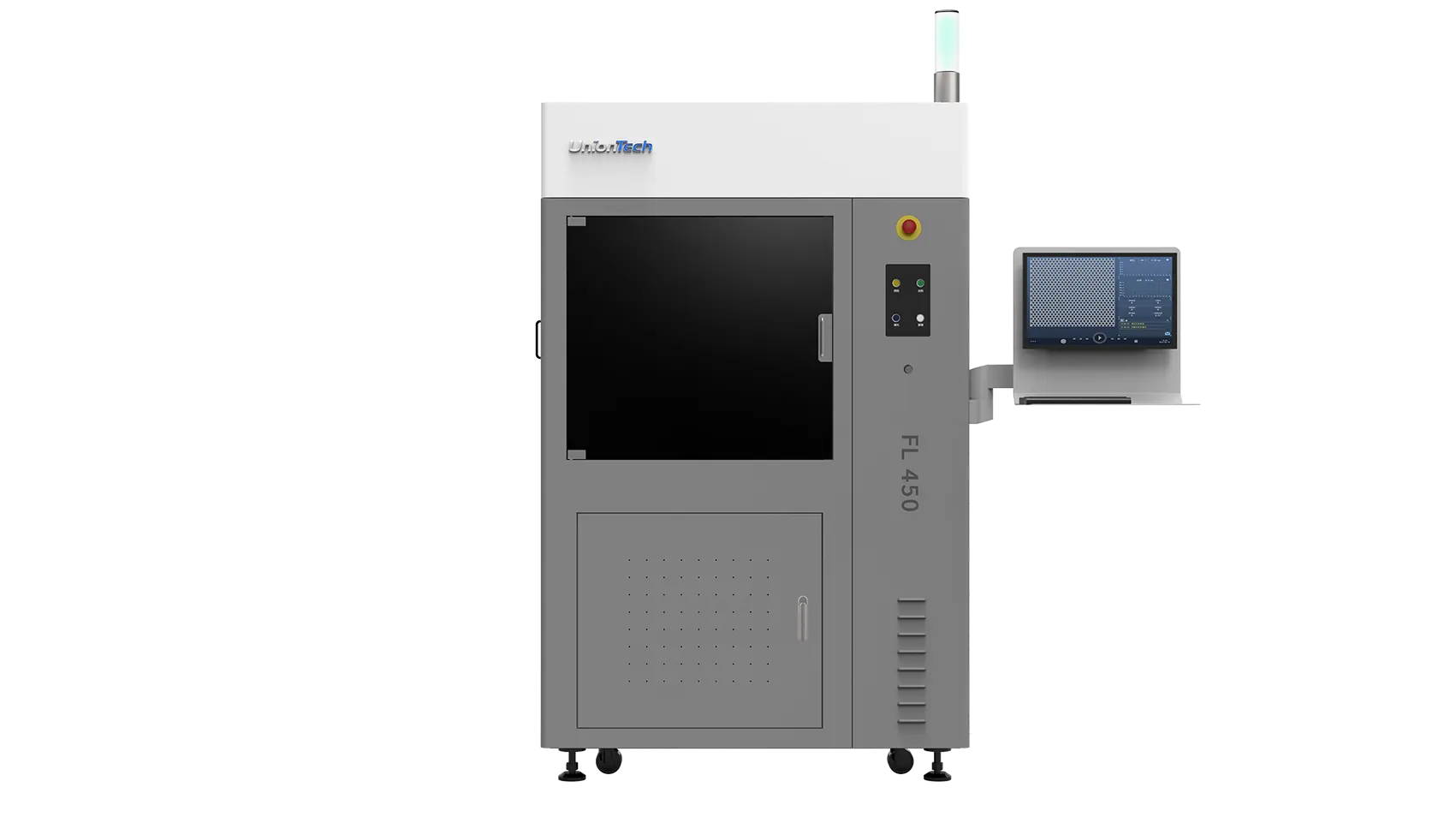
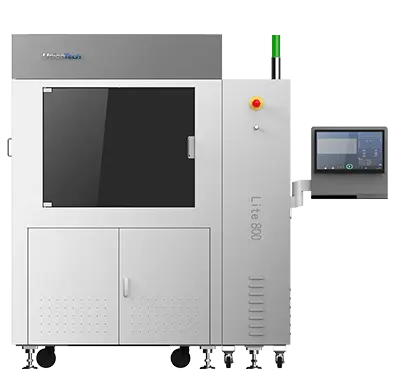
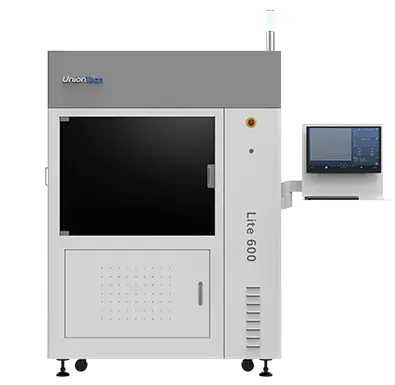
As an industrial 3D printer manufacturer, UnionTech leverages the inherent benefits of SLA technology with industrial-grade hardware and specialized software to maximize accuracy, fulfilling the stringent requirements of B2B clients in aerospace and automotive sectors.
Key features of UnionTech’s industrial SLA systems (such as the RSPro series) that contribute to their superior accuracy include:
Precision Laser System: UnionTech printers use sophisticated, highly stable laser systems with advanced optics. Features like variable spot technology allow for a smaller, tighter laser spot for fine details and a larger spot for bulk areas, optimizing both detail and speed.
Micrometer-level layer thickness control: FDM printing typically starts with a layer thickness of 100 micrometers (0.1 millimeters), while industrial-grade SLA equipment can easily achieve layer thicknesses of 0.05 millimeters or even 0.025 millimeters (25 micrometers). Finer layer thickness means the printed geometry more closely matches the CAD design, thus almost completely eliminating the “step effect” that affects the accuracy of FDM-printed parts. Optimized Build Parameters: UnionTech’s industrial printers integrate proprietary algorithms for laser scanning and calibration. This ensures that the laser spot remains precisely calibrated throughout the large build platform, guaranteeing consistent accuracy even for larger parts (some models can reach 2100 × 700 × 800 mm).
Why High Accuracy is Critical for 3D Printing in Automotive Industry
For the automotive sector, dimensional accuracy is not a luxury—it is a necessity for function, form, and safety. The applications of 3D printing in automotive industry where SLA 3D printing technology is the dominant choice, are directly tied to its precision:
| Automotive Application | Accuracy Requirement | Why SLA Excels over FDM |
| Complex Fluid Manifolds | Airtight and watertight parts for functional testing. | SLA prints are naturally dense and non-porous, ensuring seal integrity, while FDM parts are not inherently watertight. |
| Snap-Fit Assemblies | The tolerances of the mating parts are very tight (as low as ±0.05 mm). | SLA’s minimal thermal stress and superior resolution prevent warping that would make FDM-printed snap-fits fail or fit poorly. |
| Master Patterns for Casting | Near-perfect surface finish and detailed replication for tooling. | The smooth surface and high detail of SLA parts require minimal post-processing before being used as masters for silicone or vacuum casting, drastically reducing lead time. |
| High-Aesthetic Design Prototypes | Flawless surface finish for consumer-facing parts (e.g., dashboard fascia). | SLA parts emerge with an injection-molded quality finish, while FDM parts exhibit highly visible layer lines. |
This clear distinction makes the choice easy for engineers who require parts for functional validation or wind tunnel testing where a part’s geometry must precisely match the digital model.
When FDM is the Right Choice
While SLA 3D printing technology is the clear winner for accuracy and surface finish, FDM retains an important place in the manufacturing ecosystem. FDM excels when:
High Mechanical Strength/Durability is the priority, using engineering-grade thermoplastics like Nylon or Carbon Fiber-filled composites (though SLA resins are rapidly improving).
Part size is extremely large and does not require fine features (though industrial SLA systems from UnionTech can now print very large parts).
Cost and speed are prioritized for quick, low-fidelity jigs, fixtures, or non-critical prototypes.
The modern automotive workflow often employs both technologies: FDM for robust jigs and functional testing components, and SLA (backed by an industrial 3D printer manufacturer like UnionTech) for high-accuracy prototypes, complex optical parts, and master patterns.
Conclusion
When comparing FDM and SLA 3D printing technology, the difference in accuracy is stark and fundamental to the underlying processes. SLA, with its highly controlled laser curing process of liquid resin, consistently delivers the highest dimensional accuracy and best surface finish of the two. This precision is non-negotiable for high-stake industrial applications.
For companies driving innovation in the 3D printing in automotive industry, partnering with a proven industrial 3D printer manufacturer like UnionTech and leveraging their high-performance SLA machines is the key to ensuring that every prototype, master pattern, and end-use part meets the tightest tolerances required by a world-class manufacturing environment. The question is not just if SLA is more accurate, but how its superior accuracy is being used to accelerate time-to-market for the next generation of vehicles.