At UnionTech, we have witnessed a fundamental shift in how tyre molds are designed and produced. Traditional mould manufacturing relies on multi-step steel machining, chemical etching, and manual finishing—each introducing tolerance drift and extended lead times. The question we consistently answer for tyre manufacturers is this: how can 3D printed tyre mold production achieve the precision required for modern tread patterns? The answer lies in combining industrial-grade stereolithography with intelligent, automated workflows. As a trusted industrial 3D printer manufacturer, we have engineered solutions that transform complex digital tread designs into physical master molds with ±0.1 mm accuracy—without the conventional bottlenecks.
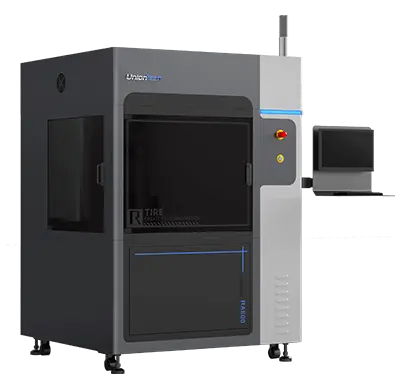
Tyre tread patterns are not merely aesthetic; they directly influence water evacuation, rolling resistance, and road noise. Achieving these geometries traditionally required CNC-machined aluminium or steel plates, which struggle with negative draft angles, undercuts, and fine siping details. UnionTech’s industrial sized 3D printer RA600 helps reduce these limitations. By curing photopolymer resin layer by layer, the RA600 reproduces tread features as fine as 0.3 mm with edge sharpness that metal tools cannot match. The result is a master mould that serves as a direct pattern for final vulcanisation, reducing post-processing by over 60% compared to metal-based methods.
The RA600 is not a general-purpose 3D printer; it is a dedicated tyre mold SLA system designed for 24/7 factory environments. Its intelligent software automatically generates optimised printing paths, meaning no manual G-code programming or overnight operator supervision. For a tyre plant running multiple pattern iterations, this translates to lights-out manufacturing. As an industrial 3D printer manufacturer, we integrate real-time resin level sensing and recoating control, ensuring that each 100-micron layer bonds uniformly across the entire build envelope. One Asian tyre client reduced their master mould lead time from four weeks to five days while achieving pattern repeatability below 0.05 mm deviation.
Traditional mould making involves nickel electroforming or chemical etching—processes that consume significant energy and hazardous materials. UnionTech’s digital approach eliminates these steps. The RA600 prints the master mould directly from CAD data without intermediate steel sheets. This integrated prototyping capability shortens production cycles from weeks to days, helps improve daily throughput and reduce material waste compared with some traditional workflows. Moreover, the shift from subtractive chemical methods to additive digital fabrication supports cleaner, more sustainable tyre mold prototyping. Every RA600 installation we have commissioned reports a measurable drop in chemical waste and energy per mould.
Precision in 3D printed tyres is not a theoretical advantage—it is a measurable production metric. UnionTech’s RA600 delivers the accuracy, automation, and eco-efficiency that modern tyre manufacturers demand. By adopting our industrial sized 3D printer, mould shops move from weeks of manual iteration to unattended overnight production of ready-to-use masters. The question is no longer whether 3D printing can achieve tyre-grade precision, but how quickly your competitors will adopt it. Let us show you the data.