At UnionTech, industrial clients distinguish professional SLA platforms from entry-level systems based on how consistently a high accuracy 3D printer performs across production scenarios. The focus is on stable output, dimensional fidelity, and workflow integration rather than single-job resolution. In practical manufacturing, operators need equipment that maintains predictable performance across varying part geometries, batch sizes, and resin formulations. Equipment is judged not by individual prints but by whether it can support continuous production tasks with minimal intervention, ensuring that engineering evaluations, prototyping, and small-batch validation remain reliable.
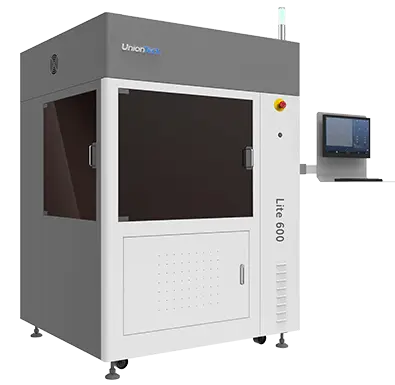
Mechanical accuracy, uniform exposure, and calibration logic are key to consistent part reproduction. Systems must ensure layers cure predictably even when part complexity changes or production cycles are extended. The high accuracy 3D printer Lite600 is designed to minimize dimensional variation across repeated builds and nested part layouts. By coordinating hardware motion, software slicing, and resin behavior, the platform enables engineers to complete multiple iterations without frequent manual adjustments. In applications like automotive components, electronic housings, and functional prototypes, this stability is essential to avoid downstream errors and maintain predictable iteration cycles.
Industrial workflows demand that equipment integrates seamlessly rather than operating in isolation. The Lite600 reflects this design philosophy by supporting structured SLA processes that maintain dimensional control across multiple part types. Users can switch between different model geometries and production schedules without impacting output quality. By embedding software, hardware, and resin coordination into a unified system, UnionTech ensures that operators spend less time troubleshooting inconsistencies and more time refining designs and validating functional performance.
Resin characteristics such as viscosity, curing response, and layer adhesion directly influence dimensional accuracy. Equipment must accommodate these variations without introducing significant drift. At UnionTech, we design process control logic so that industrial workflows can maintain stability across different resin categories. This becomes critical when transitioning from concept models to functional parts, where mechanical demands differ. Reliable performance under these conditions allows operators to predict results across iterations and ensures that output meets engineering specifications consistently.
Evaluating SLA equipment requires understanding how system design influences real production outcomes. A high accuracy 3D printer is defined by the interplay of mechanical precision, exposure control, and software coordination, not a single specification. Across industrial scenarios, equipment must maintain consistent output under variable production demands while supporting predictable workflow execution. The Lite600 embodies this approach, providing stable SLA performance for operators who need repeatable results across long-term manufacturing cycles. In professional environments, success is measured by sustained reliability and process consistency rather than short-term metrics, ensuring that prototyping and functional testing translate directly into dependable production outcomes.